
Views: 255 Author: iHot Cosmetics Publish Time: 2026-11-11 Origin: Site


Content Menu
● PDRN Skin Booster vs Traditional Peptide Serum: The Essential Difference
● Why Mature, Dehydrated Skin Needs More Than an Anti-Aging Active
>> Build the Moisturizing System First
● What PDRN Research Does—and Does Not—Tell Us
>> Do Not Transfer Injection Results to a Serum
● What Traditional Peptide Serums Can Realistically Offer
>> Read New Research by Delivery Route
● Which Option Makes More Sense for Mature, Dehydrated Skin?
>> When Moisture Comfort Comes First
>> When Fine-Line Appearance Is the Main Concern
>> When Both Products Seem Appealing
● A Practical Routine for Evaluating Either Serum
>> Morning
>> Evening
● Three Evidence Gaps Better Skincare Content Should Address
>> 1. Ingredient Evidence vs Finished-Formula Evidence
>> 2. Hydration vs Structural Anti-Aging Claims
>> 3. Consumer Preference vs Clinical Performance
● From OEM/ODM Concept to a Credible Product Brief
>> A More Useful Comparative Test
● How to Use Customer Reviews Without Overstating Results
● Develop Your Mature-Skin Formula With iHot Cosmetics
>> Is PDRN better than peptides for mature skin?
>> Can I use PDRN and peptide serums together?
>> Does a topical PDRN serum work like an injectable skin booster?
>> Are peptide serums supported by clinical research?
>> Which ingredients should accompany PDRN or peptides for dry-feeling skin?
>> How quickly should I expect visible results?
At iHot Cosmetics, we approach "PDRN Skin Booster vs Traditional Peptide Serum for Mature, Dehydrated Skin Types" with one practical question: which finished formula best addresses the user's needs? For mature skin that feels tight and looks less supple, the answer depends on hydration, tolerability, delivery, and product-specific evidence—not simply the newest ingredient.
iHot Cosmetics, operated by Guangzhou Aihuo Biotechnology Co., Ltd., provides OEM/ODM solutions for skincare, personal care, and hair care brands. Our company profile includes more than 10 years of experience, GMP-certified manufacturing, a 70,000-square-meter ISO-certified facility, 15 automated production lines, and Class 100,000 cleanrooms, serving more than 2,000 brands worldwide.
Our formulation-led perspective is straightforward: start with the skin's immediate needs, then choose the active ingredient and substantiate the finished product.

PDRN and peptides are different ingredient families. Neither automatically makes a serum better.
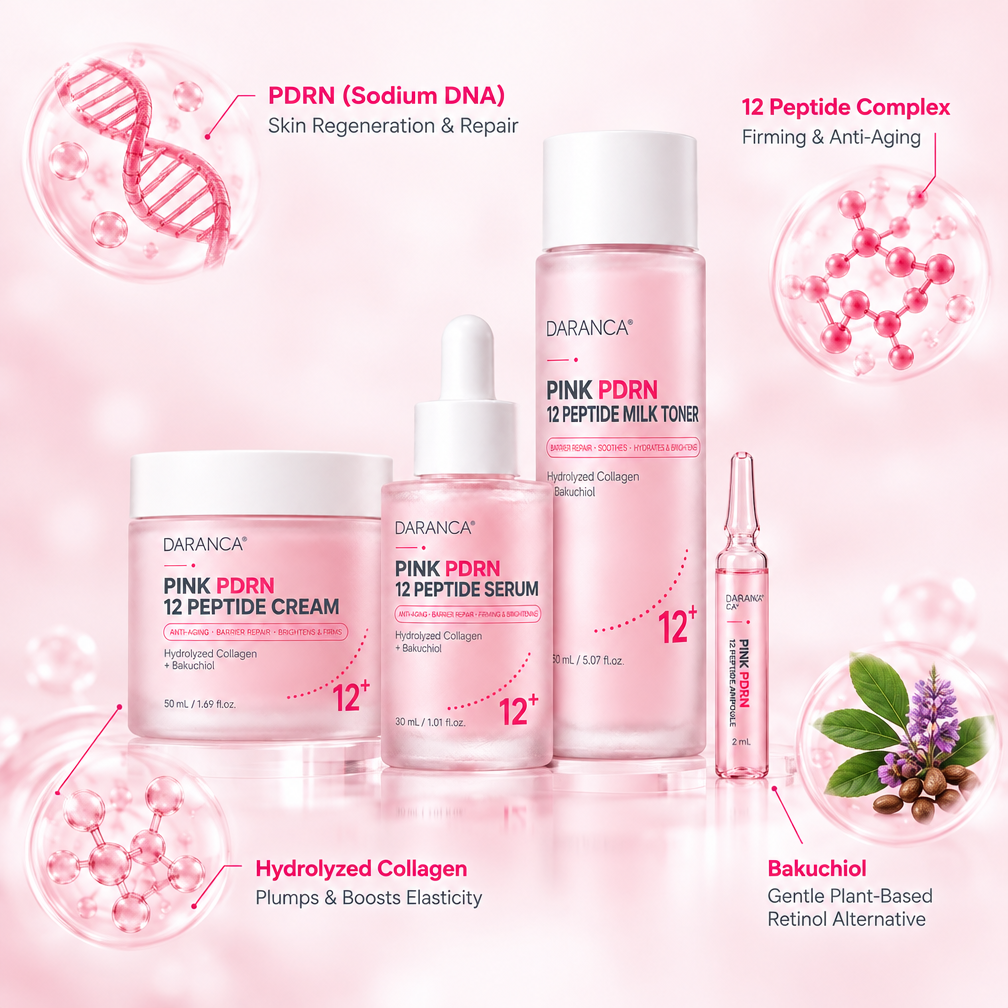
PDRN stands for polydeoxyribonucleotide, a mixture of DNA fragments investigated in regenerative medicine and dermatology. Peptides are short amino acid chains; different sequences are used in cosmetics for different purposes.
The most important distinction concerns delivery. "Skin booster" can describe an injectable aesthetic treatment or a topical cosmetic. These are not interchangeable.
This guide primarily compares topical PDRN skincare with topical peptide serums. Injectable treatments require a separate discussion with a qualified medical professional.
| Comparison point | Topical PDRN skincare | Traditional peptide serum |
|---|---|---|
| Ingredient identity | DNA-derived fragments | Short amino acid chains |
| Typical cosmetic positioning | Hydration, smoother-looking texture, skin conditioning | Fine-line appearance, firmness, smoother-looking skin |
| Evidence question | Was the tested product topical or injectable? | Was the exact peptide or finished formula tested? |
| Formulation challenge | Ingredient characterization, stability, delivery | Peptide selection, stability, delivery |
| Dehydrated-skin priority | A supportive moisturizing base | A supportive moisturizing base |
| Practical selection rule | Assess the complete formula | Assess the complete formula |
A useful routine separates two goals: improving moisture comfort and addressing longer-term visible aging.
A serum may make skin look temporarily plumper because its moisturizing ingredients improve surface hydration. That does not, by itself, demonstrate increased collagen.
Likewise, a sophisticated active cannot compensate for a routine that leaves skin uncomfortable.
For dry-feeling skin, look beyond the headline ingredient:
- Humectants, such as glycerin and hyaluronic acid, help attract water.
- Emollients improve softness and the feel of rough skin.
- Occlusive ingredients help limit moisture loss.
- Ceramides can support a barrier-focused moisturizing routine.
A lightweight serum may work well beneath a cream. For persistently dry skin, a richer moisturizer may matter more than switching between PDRN and peptides. The American Academy of Dermatology recommends considering thicker moisturizers for dry skin and identifies ingredients including ceramides and hyaluronic acid as useful options.
PDRN attracts attention because of research into tissue repair and related biological pathways. However, an interesting mechanism is not the same as demonstrated cosmetic performance.
A 2024 review of polynucleotides in aesthetic medicine described promising findings alongside substantial limitations: variable protocols, small studies, inconsistent outcomes, and limited long-term follow-up. The literature also covers different materials and delivery methods.
An injected product bypasses the skin's outer barrier. A topical serum does not.
Consequently, research involving injected polynucleotides cannot establish that an over-the-counter PDRN serum produces equivalent results. PDRN and longer-chain polynucleotides also should not be treated as identical simply because marketing groups them together.
For a topical PDRN product, useful questions include:
1. What is the ingredient's documented identity and source?
2. What amount of active material is present?
3. Was the finished product tested on people?
4. Did testing measure hydration, visible wrinkles, or another outcome?
5. Was there a suitable control?
Without these answers, "regenerative" language can communicate more certainty than the evidence supports.
"Peptide serum" is a broad category, not a standardized treatment.
Signal peptides, carrier peptides, and other peptide classes have different proposed functions. Some specific topical formulations have shown improvements in visible aging measures, but results cannot automatically be extended to every peptide blend.
A review of topical peptide treatments also highlights an important complication: many tested products contained other active ingredients or moisturizing bases, making the peptide's individual contribution difficult to isolate.
A 2026 systematic review analyzed 19 randomized trials involving 1,341 participants. However, 17 examined oral formulations and only two examined topical formulations.
That imbalance matters. Positive pooled findings about "peptides" are not blanket proof that facial peptide serums work equally well. The review also reported substantial variation between studies and inconsistent effects on some outcomes.
For buyers, the better question is not "Are peptides proven?" It is "What evidence supports this particular peptide formula?"
There is no sound basis in the reviewed evidence for declaring all topical PDRN products superior to all peptide serums.
A practical choice depends on the problem you want to solve.
Choose the product with the better moisturizing system, suitable texture, and tolerability information.
A PDRN serum with a basic watery base is not necessarily more helpful than a well-formulated peptide serum. The reverse is equally true.
Give greater weight to controlled human testing of the finished formula.
Look for clear information about participant characteristics, application frequency, assessment methods, and study duration. Before-and-after photographs are more informative when lighting, facial expression, and camera position are standardized.
You do not need both.
Start with one formula so you can evaluate comfort and performance without changing several variables. A combined PDRN-and-peptide formula may be a development option, but its superiority would need testing rather than assumption.
Treat a new serum as one part of a routine—not the entire solution.
1. Cleanse gently, avoiding a tight after-feel.
2. Apply the selected serum according to its instructions.
3. Follow with a moisturizer appropriate for your skin.
4. Finish with broad-spectrum sunscreen.
1. Remove sunscreen and makeup gently.
2. Apply the serum as directed.
3. Follow with moisturizer.
4. Avoid introducing several new active products simultaneously.
Test a new product on a small area before broader use. Stop if persistent irritation develops, and seek professional advice for ongoing redness, cracking, itching, or discomfort.
Do not inject a cosmetic serum or use it with procedures that breach the skin unless it is specifically appropriate for that use under professional guidance. The medical and cosmetic applications discussed in polynucleotide research involve materially different delivery conditions.
An informative comparison should resolve uncertainty rather than hide it.
Laboratory findings can explain why an ingredient deserves investigation. They cannot establish the performance of every product containing it.
For both categories, delivery, accompanying ingredients, and the tested formulation affect how confidently results can be interpreted.
Improved moisture measurements, smoother-looking skin, and increased dermal collagen are different outcomes.
Content should name the measured endpoint instead of translating every positive result into "reverses aging."
A pleasant texture can improve the experience of using a product. A positive review can describe that experience. Neither replaces controlled evidence of wrinkle reduction.
This distinction helps consumers understand what a product has actually demonstrated.
For iHot Cosmetics brand partners, the strongest development brief begins with the intended user and claim—not a trending ingredient percentage.
We recommend structuring the project around five decisions:
1. Define the audience: mature skin, moisture discomfort, texture preferences, and intended markets.
2. Set the primary outcome: hydration, softness, or improvement in visible fine lines.
3. Select the formula architecture: humectants, emollients, active ingredients, and packaging.
4. Plan verification: stability, microbiological quality, packaging compatibility, and appropriate safety assessment.
5. Match claims to evidence: use finished-product testing when making finished-product performance claims.
Manufacturing credentials support supplier assessment. They do not independently prove that a particular serum reduces wrinkles or outperforms another product.
For a future PDRN-versus-peptide evaluation, consider matched moisturizing bases so differences are easier to interpret.
Predefine the primary endpoint. Keep application instructions consistent. Record tolerability and consumer experience separately from instrument-based measurements.
This is a proposed testing framework—not a report of an iHot clinical trial.
No verified customer reviews were supplied for this article, so none are presented as testimonials.
For future review collection, ask specific questions:
- Did skin feel less tight after application?
- Did the texture absorb comfortably?
- Did the product layer well beneath moisturizer and sunscreen?
- Was any irritation reported?
- How consistently was the product used?
Publish authentic feedback with permission and relevant context. Do not rewrite "my skin feels softer" into "clinically proven collagen regeneration."
The right choice is not PDRN versus peptides in isolation. It is a well-designed formula with a clear purpose, appropriate testing, and honest claims.
For brands developing skincare for mature, dehydrated skin, contact iHot Cosmetics with your target market, preferred texture, packaging requirements, and intended claims.
Request an OEM/ODM formulation consultation to explore a PDRN, peptide, or combined concept, with feasibility and substantiation requirements established before launch.
Not universally. The reviewed literature does not establish category-wide superiority for topical PDRN over topical peptide serums. Compare finished formulas and relevant human testing rather than ingredient popularity.
Using two products is not necessary to obtain a useful routine. If considering both, follow their instructions and introduce products separately. Compatibility and tolerability should be assessed for the actual formulations, not assumed from their ingredient categories.
It should not be presented as equivalent. Delivery routes differ, and injectable research does not establish the performance of a topical cosmetic serum.
Some specific topical peptide formulations have clinical evidence. However, formulations and study quality vary, and much of the recent pooled peptide evidence concerns oral products rather than facial serums.
Consider a moisturizing system containing ingredients such as glycerin, hyaluronic acid, dimethicone, or ceramides, selected for the finished formula and user's needs. A serum may still require a moisturizer afterward.
There is no universal timeline. Hydration, comfort, and wrinkle appearance are different endpoints. Use the specific product's testing and instructions as your reference rather than a category-wide promise; peptide studies themselves use varying assessment periods.
1. Lee, K. W. A., et al. (2024). [Polynucleotides in Aesthetic Medicine: A Review of Current Practices and Perceived Effectiveness]. *International Journal of Molecular Sciences*, 25(15), 8224. DOI: 10.3390/ijms25158224. Supports the discussion of polynucleotide applications, delivery distinctions, and evidence limitations. [pmc.ncbi.nlm.nih]
2. Nukaly, H. Y., et al. (2026). [Oral and topical peptides for skin aging: systematic review and meta-analysis of randomized controlled trials]. *Frontiers in Medicine*, 13, 1618306. DOI: 10.3389/fmed.2026.1618306. Supports the trial counts and distinction between oral and topical peptide evidence. [pmc.ncbi.nlm.nih]
3. Schagen, S. K. (2017). [Topical Peptide Treatments with Effective Anti-Aging Results]. *Cosmetics*, 4(2), 16. DOI: 10.3390/cosmetics4020016. Supports peptide classification, formulation considerations, and limitations in attributing multi-ingredient results to individual peptides. [mdpi]
4. American Academy of Dermatology. [How to pick the right moisturizer for your skin]. Supports moisturizer selection and the discussion of ceramides and hyaluronic acid. [aad]
5. American Academy of Dermatology. [Dermatologists' top tips for relieving dry skin]. Supports practical dry-skin care and moisturizing ingredient examples. [aad]
6. iHot Cosmetics / Guangzhou Aihuo Biotechnology Co., Ltd. Company description supplied for this draft. Source of the manufacturing experience, facility size, certifications, production-line count, cleanroom classification, service categories, and brand-service figures. These details were not independently verified; no company URL was supplied.
Hot Tags: China, Global, OEM, private label, manufacturers, factory, suppliers, manufacturing company


